

The outside of a North Houston house takes a beating the inside never sees: heat, humidity, driving rain and the occasional freeze. Exterior work here is less about looks than about what survives the next ten summers.
What the Gulf Coast does to the outside of a house
Houston sits in a climate that is hard on exteriors in a very specific way. It is not the heat on its own, it is heat plus humidity plus water, repeated for most of the year. Paint films that would last a decade in a dry climate chalk and fail early here. Untreated timber holds moisture against itself. Caulk joints open, and once water is behind a joint it does not evaporate, it sits.
So the decisions that matter on an exterior job here are mostly material decisions taken before anyone lifts a brush, and they are the ones a cheap quote quietly skips.
What we do on the outside of a house
Their own homepage has advertised "Interior & Exterior painting" for years, and exterior work has always been part of what Manna does. This is the fuller picture of it.
- Exterior painting
- Pressure wash, scrape, make good, prime bare timber, then two coats of a 100% acrylic exterior paint. The preparation is the job. The paint is the easy part and it is what everyone quotes on.
- Siding and trim repair or replacement
- Rotten fascia, soft window trim, failed board ends. We replace what has gone rather than painting over it, because paint on rot buys you one season.
- Decks, porches and pergolas
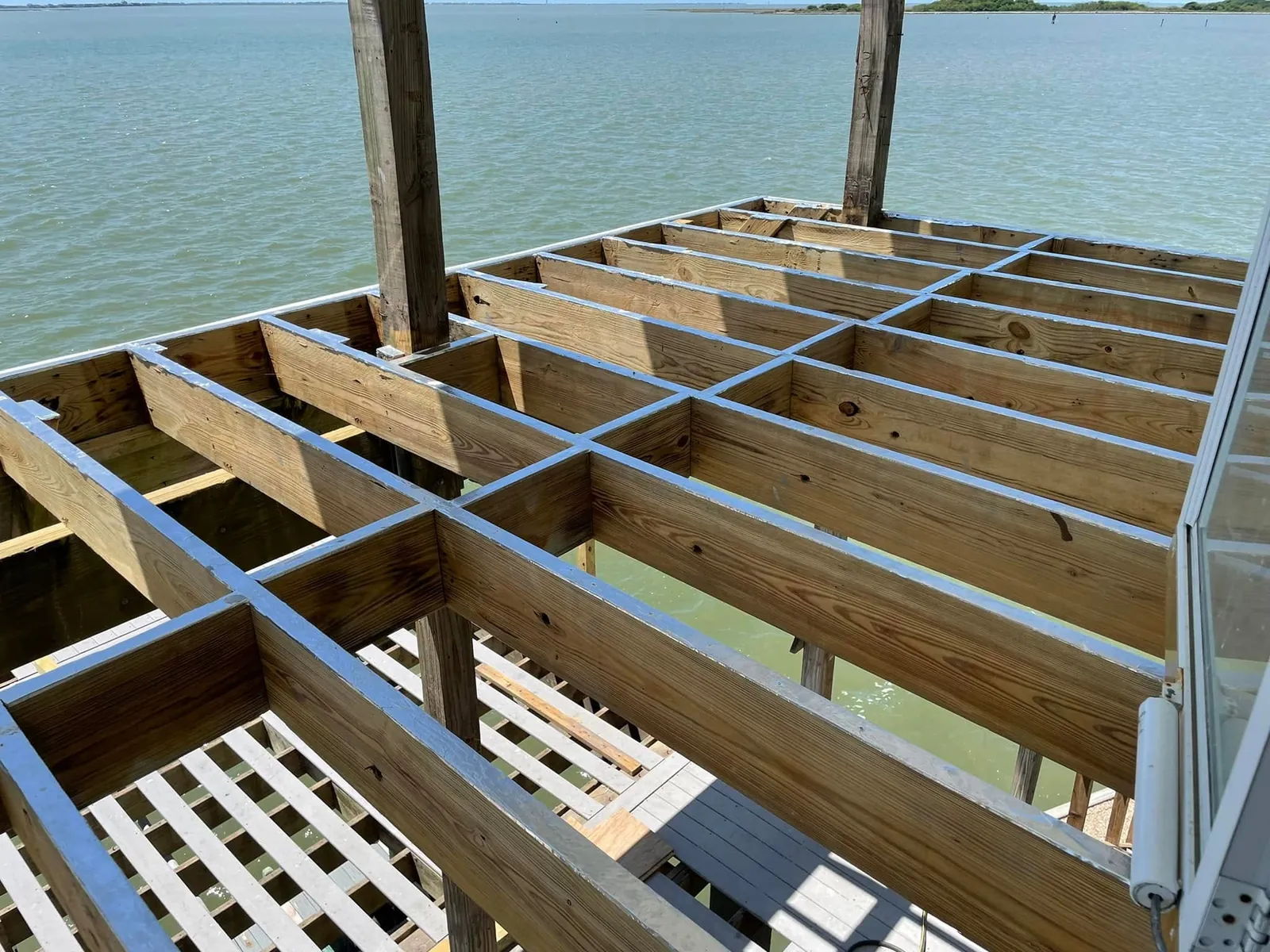
- Rebuilt, re-boarded or refinished. On the Gulf Coast the fixings and the ventilation under the boards matter as much as the timber on top of them.
- Doors and exterior windows
- Front doors, patio and French doors, and the trim and flashing around them. This is where a surprising amount of water gets in.
- Soffits, fascia and ventilation
- Unglamorous and it decides how long a roof and an attic last. Blocked or missing ventilation in this climate cooks an attic and shortens everything above it.
- Making good after a storm
- Post-storm exterior repair, including the parts an insurance scope misses. See below.
Materials that survive here, and ones that do not
There is no single right answer, but there are wrong ones, and the wrong ones are almost always chosen on price per square foot.
- Fiber cement siding
- The default recommendation on the Gulf Coast. It does not rot, it does not feed insects, and it holds paint far longer than timber. It is heavier and slower to fit, which is why a cheap quote will steer you away from it.
- Timber
- Beautiful, and it wants maintenance here in a way it does not in a dry climate. Worth it where it shows and where you will keep up with it. Not worth it on a high fascia nobody will look at again for fifteen years.
- Exterior paint
- 100% acrylic, correctly primed, with the caulk joints cut out and redone rather than painted over. Most exterior paint failures here are preparation failures, not product failures.
- Fixings and flashing
- Stainless or hot-dip galvanised near the coast. Plain steel fixings bleed rust through a paint film within a couple of seasons and there is no fixing it afterwards.
Storm, flood, and the rule that turns a renovation into a rebuild
Hurricane Harvey flooded more than 16,000 homes and 3,300 businesses in the Lake Houston area, roughly 20% of all homes in it, according to SBA estimates compiled by Reduce Flooding. In some Kingwood neighborhoods it was not one in five: The Enclave flooded 283 of 283 homes.
That history matters on an exterior job more than on an interior one, because of a single federal rule. Under FEMA's substantial improvement rule, if a repair or improvement costs 50% or more of the structure's market value before the work, the whole building has to meet current elevation standards. Exterior work reaches that threshold far more easily than a kitchen does, and it is the line where a renovation quietly becomes a rebuild.
We would rather find that line at the estimate than halfway through demolition, so on any substantial exterior project in a flood zone it is one of the first things we check.
Permits, which exterior work triggers more often than interior work
Interior finish work is exempt in a lot of cases. Exterior work frequently is not, because it more often touches the structure, the envelope or the footprint. Adding a covered porch is a different conversation from repainting one.
Roman Forest is the strictest of the communities we serve and requires a permit for remodels with or without structural change. Kingwood answers to the City of Houston, except the part of it in Montgomery County, which does not. We confirm which applies to your address before work starts rather than assuming.
Our process
Our exterior renovations process
The same steps every time, in the same order. The first one costs you nothing.
A free estimate, and an honest look at the substrate
We walk the outside with you and press on things. What is sound gets painted; what has gone soft gets replaced and priced as replacement. A quote that does not distinguish between the two is not a quote, it is a guess.
Materials chosen for the exposure
South and west elevations take the worst of it, and so do anything within splash range of a deck or a path. We specify for the elevation rather than specifying one product for the whole house.
Preparation, which is most of the work
Wash, scrape, make good, cut out and redo failed caulk, prime every bare surface. This is the part that decides whether the finish lasts three years or twelve, and it is the part a cheap quote leaves out.
Finish, then a walk round with you
Two coats, the fixings and flashing checked, the site cleared, and then we walk it together and list what is left rather than waiting for you to find it.
4.8 on Google, across 32 reviews
What our neighbors say.
Before you call
Questions we get asked
Straight answers, including the ones that talk you out of spending money.
How often does a house in this area need repainting outside?
Properly prepared and painted with a quality acrylic, expect eight to twelve years on most elevations, and less on whatever faces the afternoon sun. If yours needed doing again after three or four, the problem was almost certainly the preparation rather than the paint.
Can you just paint over the rotten trim?
We will not. Paint on rot looks fine for a season and then fails, and you have paid for the work twice. We price replacement of what has actually gone and painting of what is sound, and we show you which is which while we are standing there.
Is fiber cement worth the extra over timber?
On the Gulf Coast, usually yes. It does not rot, insects do not eat it, and it holds paint substantially longer, which is where the real saving is. It costs more to buy and more to fit. Where timber shows and you will maintain it, timber is a perfectly good answer.
Do exterior renovations need a permit?
More often than interior work does, because exterior work more often touches the structure or the footprint. It also depends entirely on your address: Roman Forest requires a permit for remodels with or without structural change, while most of Kingwood answers to the City of Houston. We confirm it for your address before anything starts.
We are in a flood zone. Does that change anything?
It can change everything, and it is worth knowing before you set a budget. Under FEMA's substantial improvement rule, work costing 50% or more of the structure's pre-work market value requires the whole building to meet current elevation standards. Exterior projects reach that threshold more easily than interior ones. We check it at the estimate.
The rest of what we do
- Kitchen RemodelingFrom the initial consultation to the final touch: cabinets, counters, flooring and paint.
- Bathroom RemodelingShowers, tubs and vanities, planned with you from the first estimate.
- Interior RemodelingBathrooms, kitchens, offices and living areas, one room or the whole home.
- FlooringHundreds of flooring options to choose from.
- TileHundreds of tiling options to choose from.
- PaintingInterior and exterior painting.
- PlumbingFixtures, rough-in and repipes, done in-house by our own licensed plumber.